Asia’s consumer and tech firms are adapting to new struggles and realities of the AI era, but their approaches can be best described as “still human.”
Read from your browser
Tech in Asia logo

Sunday Newsletter

Welcome to Tech in Asia's Sunday newsletter, your weekend brief on the biggest moves in Asia's tech and startup world. Subscribe to this newsletter or send story tips to editors@techinasia.com. Ensure our articles appear in your Google searches:

Google Preferred Source badge

IN FOCUS

  • Eileen C. Ang on the human difference
  • A new funding environment for consumer startups in the AI era
  • A growing side quest for Asia's marketplaces

Hello reader,

I have a theory that most of us, especially those who work in or keep up with tech, have AI fatigue. It's AI this, AI that, and it's nonstop.

You've got AI agents, but watch out for AI slop. You lose out if you snooze on AI prompting, but keep that human touch because it makes all the difference. AI is coming for your job - no, it's actually a helpful tool. Need friends but you can't find any? Just find an AI companion who will never be sick of your rants or call you out on your faults.

It's now an AI (or AI-first, take your pick) world, and we humans just get to live in it.

But is it, really?

Peel back the layers, and I bet you'll find humanity at the center. Our story on Asian companies selling their in-house AI tools to other businesses sounds like yet another article showing AI's chokehold on the tech industry. But when you go deeper, you'll find out that their plan hinges on using the staggering amount of consumer data that they've collected over the years. Yes, still people.

Our other editor's pick is about how consumer startups, particularly in Southeast Asia, are struggling to find funding as VCs chase AI gold. Investors appear to have lost interest in backing coffee chains, health services, e-groceries, beauty brands, and other companies that cater to human wants and needs.

However, VCs and founders in the region point out that it's still consumers who drive the economy, and smart investors don't ignore that. That said, VCs have also changed their criteria for cutting checks, so startups are pivoting accordingly.

AI fever aside, a startup's success hinges on how well it adapts to this new funding environment. And perhaps the key to it is an innately human instinct: survival.

Eileen C. Ang, co-managing editor


EDITOR'S PICKS

1️⃣ AI fever leaves SEA's consumer startups fighting for attention

The AI gold rush shows no signs of slowing or stopping, leaving some sectors like consumer startups scrambling to get investor attention. But VCs are changing their criteria for consumer plays, so startups are adjusting their business models accordingly to prove that they're worthy bets.

That said, Southeast Asia is the place to be if you're focused on consumers, as the region has a host of markets whose demographics align with the sector's target audience - young, middle class, and tech-savvy.

2️⃣ Firms are spinning off AI tools, but are clients interested?

Building AI tools for internal use is one thing; selling them to other businesses is another. Indian companies like Paytm, Eternal, Meesho, and Shiprocket have made this move, using proprietary data they've amassed over the years to underpin their AI offerings.

The hope is that these spin-offs can become high-margin businesses. But revenues remain small, their data edge fades away outside their core markets, and prices for voice AI and customer service keep dropping.

3️⃣ Tracking IPOs: Shein knocks on Hong Kong's doors

IPO activity in Asia surged in the first half of 2026: The Hong Kong Stock Exchange raised US$26.9 billion from 85 listings, while the Singapore Exchange recorded five mainboard listings. Fast-fashion brand Shein as well as fintech firms GCash, F88, and Finnomena are hopping on the IPO train this year.

For more details about which companies plan to go public, check out our regularly updated tracker.


SHORT CUTS

1️⃣ Big Cloud shows AI the money

Alphabet, Amazon, Meta, and Microsoft - the biggest cloud computing providers - indicated in their recent earnings reports that they plan to increase or maintain spending on AI infrastructure. This signals wider AI expansion and eases investor concerns around stalled data center projects and canceled leases.

2️⃣ Combine to align

ByteDance has integrated parts of the team behind Lark, its workplace software tool, into its Doubao AI chatbot and Volcano Engine cloud service teams, in line with its push to sell enterprise AI. This comes as the Chinese giant's annual recurring revenue from AI hit US$4 billion in July.

3️⃣ The price is down

After reducing operating costs, OpenAI has cut API prices for its Luna and Terra models by 80% and 20%, respectively. These models are part of the GPT-5.6 line: Sol is the workhorse, Terra sits in the middle tier, and Luna is the low-cost option.


WEEKEND DEEP DIVE

AI can't sit with us

Some observers say that AI has a PR problem: Surveys show increasingly negative public sentiment on the tech, commencement speakers who praise AI are booed or heckled, and "AI slop" is now part of everyday conversation.

But analysts from the Brookings Institute argue that this backlash is part of the growing skepticism and distrust of tech and social media, especially among the youth. This article offers a host of policy measures such as protections for labor, creativity, consumer safety, and the environment that could help build public trust in AI.


INFRASTRUCTURE FOR THE AGENTIC ERA

In conversation with the co-founder of Supabase

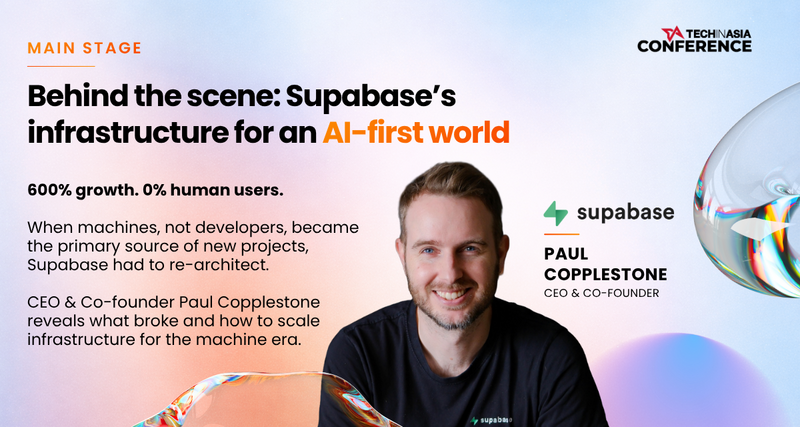
What happens when your primary user is no longer a developer but an AI agent? Supabase faced this reality head-on as AI-generated databases surged by 600% in a single year, forcing the company to totally rebuild its core platform architecture.

Join Paul Copplestone, CEO and co-founder of Supabase, at Tech in Asia Conference as he reveals exactly what broke, what was rebuilt, and how infrastructure must evolve when machines become the primary creators of software.

From the security risks of agent-written code to the shifting economics of machine-speed usage, this conversation aims to provide a tactical road map for anyone building in an AI-native world. Move beyond the hype and learn what it takes to support the next era of business.

Get your tickets at a 60% discount here.

ADVERTISE | SUBSCRIBE | HIRE | FIND JOBS

P.S. Don't miss out on the biggest tech news and analysis. Add newsletter@techinasia.com to your address book, contacts, or safe sender list. Or simply move us into your inbox.

Tech in Asia thanks our partners for supporting our newsletters. Sponsorship has no influence on editorial content.

Too many emails?
Switch to a different frequency or get new content through our preference center, or unsubscribe.

You can also remove yourself from all Tech in Asia emails over here.


Copyright © 2026 Tech in Asia, All rights reserved.
Tech in Asia (Podium Level 3), 1000 Toa Payoh North, News Centre, Singapore 318994