Cheap to build doesn’t mean it’s easy to sell. Our top AI stories on microdramas, games, and GPUs make that painfully clear.
Read from your browser
Tech in Asia logo

The Prompt

Welcome to The Prompt, your Monday dive into the world of AI that puts Asia front and center. From Big Tech's power players to the region's scrappy disruptors, we cover it all. Subscribe to get full access to our AI reporting. Ensure our articles appear in your Google searches:

Google Preferred Source badge

Hello reader,

Boiled down to the simplest form possible, there are two ways for a business to make more money: boost revenue or cut costs. Our top AI stories this past week show that AI may have mastered the latter, but the former is proving tricky.

Take Elyssa's story on how AI is being used in the production of microdramas. While the tech can cut production costs by up to 90%, removing that constraint doesn't solve the other one: audience attention.

One microdrama CEO Tech in Asia spoke with estimates that only 20% of short-video viewers globally have ever watched a microdrama, illustrating how making supply cheaper doesn't manufacture demand.

From videos you watch to video games you play - and even make - Glenn's story on AI-generated games shows a similar pattern playing out.

Companies like PixVerse and Roblox are letting users generate playable games from a text prompt. But on Chinese platform TapTap, where 80% of the 5,000 playable games it released in the first half of the year were AI-generated, user numbers stayed flat. You can build it, but it doesn't mean players will come.

Elsewhere in AI, the constraint isn't a supply glut with questionable demand, it's the opposite: GPU supply is struggling to keep up with the huge demand for compute. Pranav looks into the AI labs unable to beat China's open models, now pivoting to rent out the GPUs they secured for training so they can serve customers their erstwhile competitors' models instead.

For now, it's better to be short on supply than short on demand.

Peter Cowan, engagement editor


TOP AI READS FROM OUR DESK

1️⃣ AI came for microdramas. Now it wants the whole picture

The microdrama industry is projected to hit US$14 billion in revenue this year, and AI-generated titles like Fruit Love Island are becoming part of it.

Was watching 17 seconds of it enough to make me want to blow my brains out? Yes. But is it wildly popular? Apparently also yes, with 36.6 million views on TikTok for its first episode.

The tech that generates these shows is already a commodity, as anyone can rent it. What's valuable is standing between the content and TikTok's audience, which is why studios want to become distributors, not just producers.

2️⃣ Write a prompt, create a video game. Will players bite?

AI has made creating hyper-personalized games a reality, something that may have seemed far-fetched not so long ago. What's less clear is whether a game made for an audience of one can ever be a business built for millions.

This story explores two types of business models for AI video game creation: one where anyone can make a game on an existing platform, and another where a player creates a game just for themselves. Both are still in their early days, but experts are already questioning their long-term viability.

3️⃣ Frontier dreams stall as labs turn to hosting Chinese models

Mid-market AI labs like Sarvam and Mistral are still developing their own LLMs, but as they inch toward making their own product commercially successful, why not cash in on their GPUs?

Both are now serving rival Chinese open models on the same chips they secured to train their own. It's a hedging of their bets, allowing them to monetize their compute while they keep building toward their actual goal.


WHAT WE THINK

1️⃣ Nvidia's next chip is a face

Nvidia is a chipmaker, right? Reports last week that it plans to spend almost US$13 billion to acquire Hugging Face would suggest it has bigger ambitions than having a stranglehold on AI infrastructure.

Hugging Face doesn't make a single chip - it's the platform where developers grab and share AI models, datasets, and demo apps. So why is it Nvidia's biggest acquisition ever? The answer may be that Jensen Huang has ambitions to own chips and distribution.

As Google and Meta build custom chips to loosen Nvidia's grip on training, Nvidia is reaching for the layer neither can route around: the place where AI models get shipped, tested, and used.

2️⃣ Paris Hilton, AI influencer
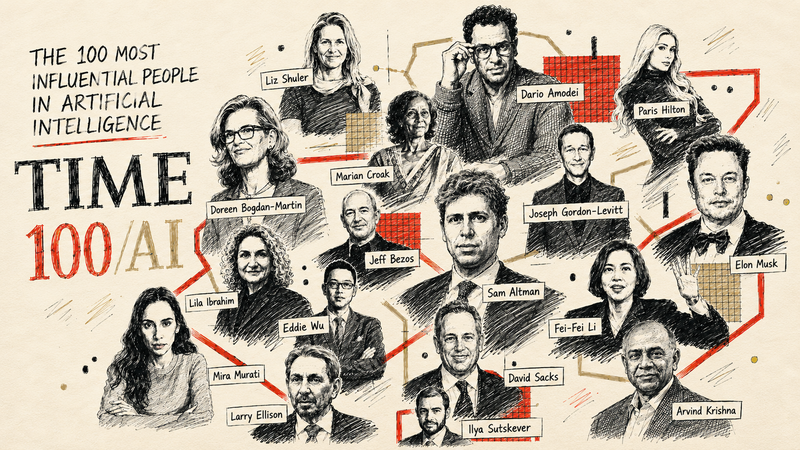
What do Sam Altman, Ben Affleck, and Paris Hilton all have in common? Apart from being fabulously wealthy, they're all also among the 100 most influential people in AI, apparently.

Time recently released this year's list of the most important people involved with the most important tech in the world. It's a real who's who, covering the gamut from founders to innovators and thinkers.

While it would be easy to poke fun at Time for including the likes of Hilton and Joseph Gordon-Levitt (and believe me, there's a version of that newsletter on the tip of my typing fingers), a quick read of their entries makes the logic clear. Both are using their considerable heft to campaign against the dangers of AI, with Hilton speaking out against deepfakes and Gordon-Levitt working to protect creators.

If we're being honest, Altman, Dario Amodei, and Elon Musk have orders more influence over AI than even celebs like Paris Hilton, so them all being on the same top 100 is telling a bit of a fiction. But maybe we'd all be better off if reality TV stars and actors were in charge of the LLMs ruling our world.


RESEARCH SPOTLIGHT

Slop is in the data, not just your head

If you're anything like me, you've been hammering the "Seems like AI slop" button since LinkedIn launched it in July. Maybe I've been wrong sometimes, but it does feel like almost everything I read on social media has the same AI slop texture.

Beyond intuition, this research paper shows that the AI slop feeling is measurable - and that it has been happening since ChatGPT exploded.

A team of USC researchers tracked linguistic diversity across over 880,000 texts (from places like Reddit, Patch community news, and arXiv computer science abstracts) from 2018 to late 2024. They found that writing has become significantly less varied, with different writers' styles converging toward the same middle.

It's also harder to infer who a writer is from their prose, such as their age, gender, or political affiliation. Instead, AI rewrites skew toward older, male, and more politically liberal, no matter who actually wrote it.

So maybe think twice the next time you use AI to clean up a social media post or some marketing copy. Because whatever you're trying to say, you may end up sounding like everyone else.


Catch up on past issues of the newsletter here. In the meantime, if you have any feedback or ideas, feel free to get in touch with Huong, our managing editor, at huong@techinasia.com.

ADVERTISE | SUBSCRIBE | HIRE | FIND JOBS

P.S. Don't miss out on the biggest tech news and analysis. Add newsletter@techinasia.com to your address book, contacts, or safe sender list. Or simply move us into your inbox.

Tech in Asia thanks our partners for supporting our newsletters. Sponsorship has no influence on editorial content.

Too many emails?
Switch to a different frequency or get new content through our preference center, or unsubscribe.

You can also remove yourself from all Tech in Asia emails over here.


Copyright © 2026 Tech in Asia, All rights reserved.
Tech in Asia (Podium Level 3), 1000 Toa Payoh North, News Centre, Singapore 318994