Hello Demo,
There seems to be a growing disconnect between what investors are willing to pour into a private AI company and what they will cough up for those that have gone public.
In recent weeks, Chinese AI companies have raised hefty funding rounds from VC and private equity firms.
 Image credit: Made by Ulla/Tech in Asia with the help of AI Chinese LLM developer Moonshot closed a new funding round that pushed its valuation to US$50 billion. DeepSeek is also looking to raise about US$12 billion in a new round. Both are reportedly preparing for their public debut next year.
Yet, those that have gone public on the Hong Kong Stock Exchange (HKEX) have seen their share prices drop just mere months after their market debut.
The share price of agentic model maker Z.ai, formerly known as Zhipu AI, has tumbled by 26% from its closing peak of HK$2,410 (US$307.10) in July. Fellow model developer MiniMax has seen its share price skid by almost 40% since its market debut on January 9, when it closed at HK$345 (US$43.96).
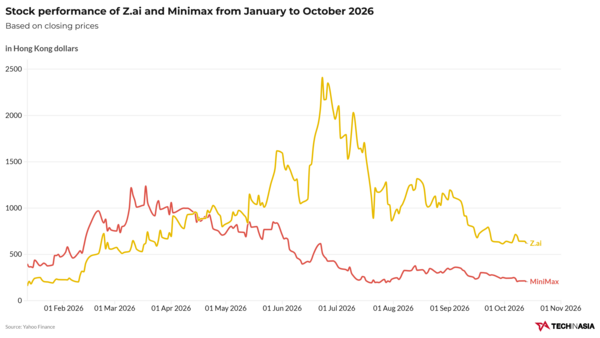
These developments show how much more scrutiny AI firms face from public markets than from their private backers. Private investors are betting on the growth potential of these AI companies, while the markets want profit.
Even data center operators, some of the biggest beneficiaries of the AI boom, have pushed back or withdrawn their IPO plans.
Australia-based Firmus, which has operations in Southeast Asia, has cancelled its market debut plans. The Nvidia-backed firm’s IPO was expected to be the biggest Australian Securities Exchange listing in almost 30 years, yet that storyline was still not enough to get it to the finish line.
Some investors in the country say “confidence evaporated” for Firmus as it was still unprofitable.
Financial analysts have cautioned that the IPO window for AI companies may be shrinking.
As early as August, PitchBook warned that wars, rising energy prices, and “AI’s draining of moats around business models across industries” has dissipated investor confidence in VC-backed IPOs.
If Anthropic’s expected November debut doesn’t go well, it could sink AI listing dreams far and wide.
Elyssa Lopez, journalist
Editor’s note: This is the Wednesday edition of The Prompt, our AI newsletter that comes out twice a week. Catch up on Monday’s edition, where we looked at ElevenLabs’ India ambitions.
WHAT ELSE WE’RE THINKING
1️⃣ Anthropic says hello lah to Singapore
 The Singapore office is Anthropic’s fourth location in Asia, following Japan, India, and South Korea. / Photo credit: Anthropic Anthropic is arriving in Southeast Asia, with its Singapore office opening today.
It chose the city-state for good reason. Singapore placed second among countries in the Anthropic Economic Index, which ranked the number of Claude users relative to a market’s population.
When it first announced the news, Anthropic said the move was driven by strong enterprise demand from this side of the globe.
Indeed, a McKinsey report made in collaboration with EDB Singapore and Tech in Asia has shown that more than half of enterprises in Southeast Asia have gone beyond experimentation when it comes to AI use, higher than the global average.
Anthropic faces tough competition against rival OpenAI. The latter opened its Singapore office in 2024, and it has already inked multiple partnerships with some of the biggest names in the country and beyond, including the local government and ride-hailing giant Grab.
Curiously, despite the firm’s active partnership-building in the region, OpenAI only hired its first executive head for the region in August – just a few weeks before Anthropic announced it was opening shop in Singapore.
Meanwhile, Anthropic’s general manager for the region is an ex-OpenAI employee.
2️⃣ The rise of US-branded open-source models
Ever since DeepSeek made headlines last year for performing just as well as US frontier AI models with less computing power, some American AI companies have been working double time to prove they can do the same.
And Nvidia hopes to be their godfather.
The firm is reportedly seeking to either invest in or buy Reflection AI, a US-based maker of open-weight AI models.
Founded in 2024, Reflection AI says its latest model Beam can rival those from China – namely DeepSeek, Qwen, and Z.ai – in terms of performance and cost. Beam can reportedly perform as well as Z.ai’s flagship model GLM-5.2 in terms of reasoning, but with two to three times less compute.
It’s not the only move Nvidia is making in the open-source space. In August, it signed a licensing deal with another US open-source model maker – Poolside. The startup also says it can work just as well as DeepSeek’s frontier models but at a lower cost.
These moves show that even the industry knows enterprises are hitting their limits when it comes to AI spending. The era of tokenmaxxing is over.
With more enterprises adopting token-hungry AI agents, using open-source models is the economical choice. For those doing business in the US, finding a partner that will not ruffle the feathers of the US government may be a safer bet than using a cheaper model from China.
AN EXPERT VIEW ON AI
We speak with leaders about how their companies are putting artificial intelligence to work. In this edition, Tech in Asia’s senior editor Melissa Goh speaks with Federico Torreti, vice president of artificial intelligence at Oracle, who has a bird’s-eye view on how hundreds of thousands of enterprises are applying the technology.
Torreti, whose career in AI precedes the genAI boom, talks about why measuring AI through vanity metrics isn’t particularly useful, common mistakes companies make when designing AI pilots, and how he’s exploring the tech alongside his two young sons.
The interview has been edited for brevity and clarity.
 Federico Torreti, vice president of artificial intelligence at Oracle / Photo credit: Oracle What does your job as “VP of AI” entail? What does a typical day look like for you?
A large part of my work is focused on having conversations with customers and understanding how they’re thinking about using AI to make it useful in the context of how they operate it.
A lot of those conversations quickly move away from the technology and more into how the organization actually works.
I also spend a lot of time working backward from customer problems, understanding how tech can enable them and what obstacles they face in terms of extracting the value from technology for their businesses.
Where has AI moved the needle for Oracle’s biggest enterprise clients?
A good example in the region is the work we’ve done with SMRT Corporation. SMRT has taken a conscious effort in understanding how best to extend the rich context that they have on their transportation network and develop an effective predictive maintenance system combining maintenance history, asset information, usage, and condition monitoring.
For SMRT, that translates to clear OpEx advantages. Their commuters have also seen the highest level of availability since the deployment of this technology.
You’ve argued that token burn rate isn’t a particularly useful measure of how effectively an organization is using AI. What should companies be measuring instead?
A lot of companies get stuck in this notion of vanity metrics: how much faster they are at doing something, agent count, or how many tokens have been consumed. Unfortunately, in many cases, such vanity metrics are taken as proxies for business value, and I don’t think that’s quite right.
Some organizations claim that their people are now able to submit these invoices in a much faster way, freeing them to do more strategic work. But even that statement, I find to be incomplete. You have to be specific – what work? What decisions are they now able to make because they have more mental capacity? How are their responsibilities or performance changing?
If an analyst for an accountant is spending less time assembling proposals or submitting invoices, we should identify where the capacity actually went. It’s important to think through the lens of an end-to-end business process and not within organizational silos.
What’s one thing companies underestimate about how difficult it is to do?
Companies underestimate how easily AI-generated content can pass for finished work, leaving someone else to supply the missing context, checking, and judgment.
The hard part is giving an agent enough context to know whether the work is ready to move forward, what remains unresolved across other systems, and who can authorize the next step.
For example, an agent might produce a polished customer proposal. If it is forwarded without checking whether it reflects the latest conversation or includes commitments the business can make, the next person has to investigate and correct it.
While the proposal was produced quickly, the work required to make it usable has been passed downstream. That effort is easy to overlook when success is measured through logins, chats, or the volume of documents generated.
Companies need to assess whether the whole AI-enabled process delivers a better result. They need to measure whether the customer gets a correct answer sooner, whether fewer mistakes reach the next team, and whether the total effort has fallen, not just that of a task.
As Southeast Asian companies look to apply AI in their operations, is there one thing that they should be doing more of, or something they can learn from their peers globally?
It’s less about the region or geography and more about the maturity that companies might have in embarking with the adoption of the technology. The conditions that make a pilot successful can hide what it would take to actually operate a viable business. That would be the one thing that I would want to make sure that companies in the region focus on.
We talked about the productivity paradox where you focus on the pilot on the submission of invoices, but you ignore the fact that there is something that happens after you submit them.
The other aspect is that there is hidden implicit knowledge. When designing a pilot, there is a risk of creating a protective environment where you have familiar questions, employees who are quietly correcting mistakes. All these emerge the moment that the system is exposed to the real world.
You have two young sons. When did you begin exposing them to AI, and what are those interactions like? What lessons do you try to instill in them through those interactions?
My sons are five and eight. We started exploring AI together over a year ago, when my older son was in first grade, and his younger brother joined us too.
One activity is storytelling. My older son writes a story on paper, with his own characters and plot. We photograph the page and use AI to create illustrations from his writing. When an illustration doesn’t match his idea, he has to explain what he wants to change.
I enjoy working alongside them because we go through the creative process together: imagining, describing, testing, and revising. The technology makes their ideas tangible, while they remain the authors.
I want them to use technology in ways that help them develop their critical thinking: making a guess, questioning an explanation, and deciding whether something makes sense.
What AI tools do you use daily, and for what use cases?
I use ChatGPT, Gemini, and Claude regularly. They have access to my notes in Obsidian, where I keep reflections that I write myself, alongside articles I’ve read and others I need to read. I’ve built that collection over time as a record of my thinking, reading, and unresolved questions.
I use AI to examine that material alongside new ideas. Where does an article challenge something that I previously believed? Have I changed my position without recognizing it? When I’m developing an argument, what am I missing, which assumptions are weak, and what would someone who disagrees say?
I also ask it to suggest readings that take me in a different direction, and it has suggested authors who disagree with my conclusions.
Catch up on past issues of the newsletter here.
|